CT Scan: What It Is, How It Works, Preparation, Cost & Important Information
A CT Scan (Computed Tomography Scan) is an advanced medical imaging test used to create detailed cross-sectional images of the inside of the body. It combines multiple X-ray images with computer technology to produce clear and detailed pictures of organs, bones, blood vessels, and soft tissues.
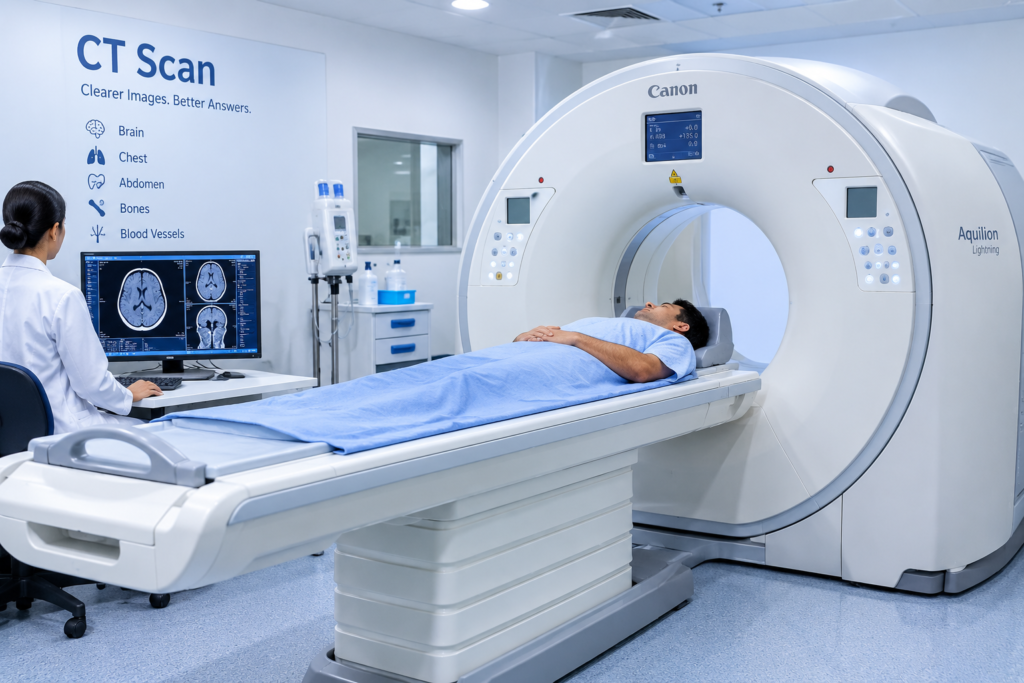
Doctors may recommend a CT scan to investigate symptoms, detect injuries, diagnose certain medical conditions, or monitor the progress of treatment.
What Is a CT Scan?
CT stands for Computed Tomography. A CT scan uses X-rays and computer processing to create detailed images of different parts of the body.
Unlike a standard X-ray, which usually produces a flat image, a CT scan can generate multiple cross-sectional images. These images can also be reconstructed to provide a more detailed view of internal structures.
CT scans are commonly used in hospitals and diagnostic centres because they can provide useful information quickly.
Which Body Parts Can Be Examined With a CT Scan?
A CT scan can be performed on many areas of the body, depending on the patient’s symptoms and the doctor’s recommendation.
Common CT scans include:
- CT Brain – for evaluating the head and brain
- CT Chest – for examining the lungs and chest structures
- CT Abdomen – for imaging abdominal organs
- CT Pelvis – for examining structures in the pelvic region
- CT Spine – for evaluating the spine and surrounding structures
- CT Sinuses – for examining the sinus region
- CT Angiography – for detailed imaging of certain blood vessels
- CT Whole Body – performed in selected medical situations when recommended
The appropriate CT scan depends on the patient’s medical condition and the area that needs to be examined.
Why Is a CT Scan Done?
Doctors may recommend a CT scan for several reasons. It can provide detailed information about bones, organs, blood vessels, and other internal structures.
A CT scan may be used to evaluate:
- Head and brain injuries
- Bone fractures
- Chest and lung conditions
- Abdominal pain
- Kidney stones
- Internal injuries
- Certain infections
- Abnormal growths or masses
- Blood vessel problems
- Certain cancers and their treatment response
The doctor decides whether a CT scan is appropriate based on the patient’s symptoms and medical history.
How Does a CT Scan Work?
During a CT scan, the patient lies on a motorized table that moves through a large, circular opening in the CT scanner.
As the table moves through the scanner, an X-ray tube rotates around the body and captures multiple images from different angles.
A computer processes these images to create detailed cross-sectional pictures of the body.
During the scan, you may be asked to remain still or briefly hold your breath, depending on the type of examination.
How to Prepare for a CT Scan
Preparation depends on the type of CT scan being performed.
Before your appointment:
- Follow the instructions provided by your diagnostic centre.
- Wear comfortable clothing.
- Remove metal objects if instructed.
- Inform the medical staff about any medical conditions.
- Tell the staff if you are pregnant or think you may be pregnant.
- If contrast is required, follow any fasting or preparation instructions given by the centre.
If you take regular medications or have a known allergy, inform your doctor or the CT scan team before the examination.
What Is a Contrast CT Scan?
Some CT scans are performed using a contrast agent. Contrast can help certain organs, blood vessels, or abnormal areas appear more clearly on the images.
Depending on the examination, contrast may be given orally or through an injection.
Not every CT scan requires contrast. The doctor or radiologist decides whether contrast is necessary based on the type of examination and the medical indication.
Before receiving contrast, inform the medical team about relevant allergies, kidney problems, previous reactions to contrast, pregnancy, or other important medical information.
Is a CT Scan Safe?
CT scans use X-rays, which involve exposure to ionizing radiation. The amount of radiation depends on the type of scan and the scanning protocol.
Doctors generally recommend CT scans when the expected diagnostic benefit is considered to outweigh the potential risks.
If you are pregnant or may be pregnant, inform your doctor and the imaging team before undergoing a CT scan.
How Long Does a CT Scan Take?
A CT scan is usually a relatively quick imaging examination, although the total appointment time can vary depending on the type of scan.
If contrast or additional imaging is required, the process may take longer.
Your diagnostic centre can tell you the expected duration when you schedule your appointment.
How Much Does a CT Scan Cost?
The cost of a CT scan can vary depending on several factors, including:
- Type of CT scan
- Body part being examined
- Diagnostic centre
- Location
- Whether contrast is required
- Type of CT equipment used
For this reason, it is recommended to confirm the current CT scan price with the diagnostic centre before booking an appointment.
What Happens After a CT Scan?
After a routine CT scan, most patients can usually continue their normal activities unless their doctor provides different instructions.
If contrast has been used, follow the instructions provided by the medical staff.
The images are reviewed by a qualified radiologist, who prepares a report based on the findings. Your doctor can explain the report and recommend further tests or treatment if necessary.
CT Scan vs X-Ray: What Is the Difference?
Both CT scans and X-rays use X-rays to produce medical images, but they work differently.
A standard X-ray generally produces a two-dimensional image, while a CT scan captures multiple images from different angles and uses computer processing to create detailed cross-sectional images.
Because CT can provide more detailed information, it may be recommended when a standard X-ray does not provide enough information.
CT Scan for Kidney Stones
CT scans can be particularly useful when doctors need detailed imaging for suspected kidney stones.
A CT examination can help identify the location and size of a stone and provide information about the urinary tract.
However, the appropriate imaging test depends on the patient’s age, symptoms, medical history, and clinical situation. The doctor decides which examination is most suitable.
Why Choose a Reliable Diagnostic Centre for a CT Scan?
Choosing a reliable diagnostic centre is important for accurate imaging and proper patient care.
Before booking a CT scan, consider:
- Quality and maintenance of imaging equipment
- Qualified radiology professionals
- Proper patient preparation
- Clear appointment process
- Appropriate safety protocols
- Timely reporting
- Transparent information about the test and charges
It is also useful to ask whether contrast is required and whether any special preparation is necessary.
Frequently Asked Questions About CT Scans
1. What is the full form of CT Scan?
CT stands for Computed Tomography.
2. Does a CT scan use radiation?
Yes. CT scans use X-rays, which involve ionizing radiation.
3. Is a CT scan painful?
A CT scan itself is generally painless. You may need to remain still during the examination.
4. How long does a CT scan take?
The duration depends on the type of CT scan. Many examinations are relatively quick, but contrast studies or additional imaging may require more time.
5. Does every CT scan require contrast?
No. Some CT scans are performed without contrast, while others may require it depending on the medical indication.
6. Can I eat before a CT scan?
It depends on the type of CT examination and whether contrast is planned. Always follow the preparation instructions provided by your diagnostic centre.
7. Can pregnant women have a CT scan?
If you are pregnant or may be pregnant, inform your doctor and the imaging team before the scan. Your doctor will decide whether the examination is appropriate.
8. Can a CT scan detect kidney stones?
Yes, CT imaging can be used to detect and evaluate kidney stones in appropriate clinical situations.
Conclusion
A CT Scan is an important diagnostic imaging test that provides detailed images of the body’s internal structures. It can be used to examine the brain, chest, abdomen, bones, blood vessels, urinary system, and many other areas.
Because CT scans use X-rays, they should be performed when medically appropriate. Proper preparation and communication with the medical team can help make the examination safe and effective.
If your doctor has recommended a CT scan, contact a reliable diagnostic centre to confirm the type of scan, preparation requirements, contrast requirement, availability, cost, and reporting time before your appointment.